What Is Off-Page SEO? (Quick Answer)
Off-page SEO is everything you do outside your own website to improve where it shows up in search results.
In short:
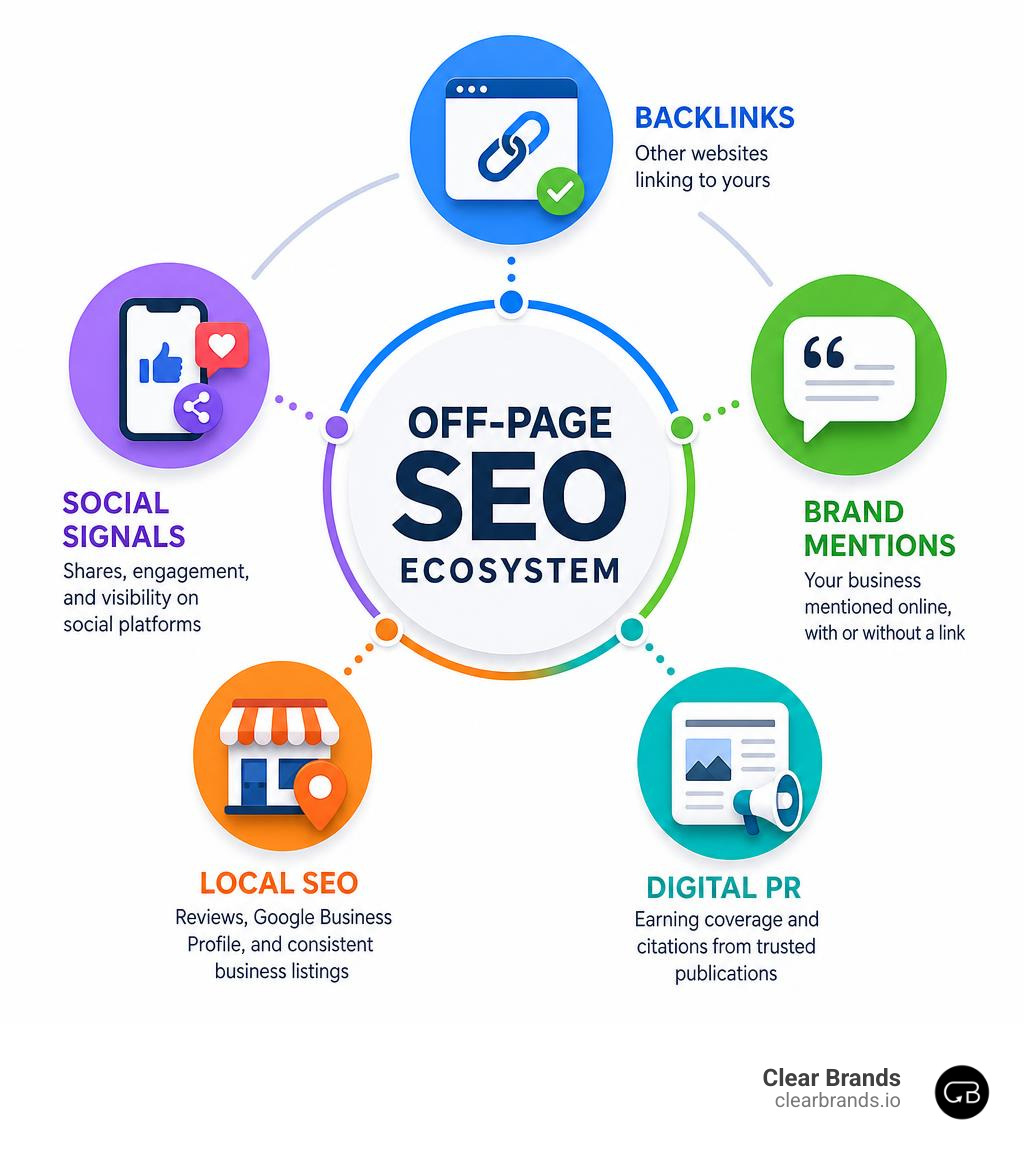
- Backlinks — other websites linking to yours (the most important factor)
- Brand mentions — your business being talked about online, even without a link
- Social signals — shares, engagement, and visibility on social platforms
- Local SEO — reviews, Google Business Profile, and consistent business listings
- Digital PR — earning coverage and citations from trusted publications
Search engines use these external signals to decide whether your site is trustworthy and authoritative — not just relevant.
Here’s the thing most small business owners miss: you can have a perfectly built website with great content, and still sit on page three of Google. Why? Because search engines don’t just read your site — they look at what the rest of the internet says about you.
Think of it like a reputation. If other trusted sources are vouching for you, Google pays attention. If no one’s talking about you, it’s hard to earn that top spot — and 71% of all clicks go to results on the first page.
That’s the core problem off-page SEO solves.
I’m Cristian Droescher, founder of Clear Brands, and through years of helping local service businesses and national brands build lasting online visibility, off-page SEO has consistently been the missing piece that moves the needle when everything else is already in place. The sections ahead break down exactly how it works and what to do about it.
Understanding Off-Site Optimization and Its Importance
When search engines crawl the web, they are essentially trying to answer one fundamental question: Which website is the most trustworthy source of information for this specific query?
While your own website can claim to be the absolute best in your industry, search engines cannot fully trust a website’s self-assessment. They need third-party validation. This is where off-site optimization comes into play.
By analyzing external signals, search engines can evaluate your site’s real-world reputation. If high-quality, reputable websites continuously reference your content, point links to your pages, and mention your brand name, search engines recognize your business as a trusted authority.
This process directly feeds into Google’s core evaluation framework known as E-E-A-T (Experience, Expertise, Authoritativeness, and Trustworthiness). Trust is the most critical element of this framework, and it is built primarily through off-site signals. When search engines observe online reviews, expert recommendations, and mentions of your business on authoritative publications, your domain authority and search engine rankings naturally rise.

The Difference Between On-Page and Off Page SEO
To build a balanced digital marketing strategy, you must understand how different types of search engine optimization interact. We like to think of SEO as a three-legged stool: on-page SEO, technical SEO, and off-page SEO. If any leg is missing, the stool falls over.
- On-Page SEO is the practice of optimizing elements directly on your website. This includes writing high-quality content, targeting strategic keywords, structuring your URLs, and optimizing meta tags. You have 100% control over these elements. Learn more about mastering these on-site elements in our comprehensive guide to On-Site SEO.
- Technical SEO deals with the underlying infrastructure of your website. It ensures search engine spiders can easily crawl and index your pages, focusing on site speed, mobile-friendliness, secure connections (HTTPS), and XML sitemaps. Read our deep dive into Technical SEO to ensure your site’s foundation is rock-solid.
- Off-Page SEO focuses on external signals that occur entirely outside of your website. It is the process of building authority, trust, and relationship networks across the web to prove to search engines that your site deserves to rank.
| SEO Pillar | Focus Area | Key Elements | Direct Control? |
|---|---|---|---|
| On-Page SEO | Content & Relevance | Keywords, Meta Tags, Headings, Internal Links | Yes |
| Technical SEO | Site Performance & Indexing | Speed, Mobile Usability, Schema Markup, XML Sitemaps | Yes |
| Off-Page SEO | Authority & Trust | Backlinks, Brand Mentions, Reviews, Digital PR | No (Influenced) |
Why Off-Site Authority Matters in 2026
In May 2026, the search landscape is more competitive and sophisticated than ever before. Google’s algorithm has evolved far beyond simple keyword matching. However, the core foundation of Google’s ranking system—originally established by the PageRank algorithm in 1998—remains highly active. PageRank treated backlinks as “editorial votes” from other websites, and that fundamental concept still dictates search engine rankings today.
In fact, modern industry studies confirm that a website’s Domain Authority Score is the sixth strongest predictor of a webpage’s ranking position. Because 71% of all clicks happen on the first page of search results, building external authority is not optional if you want your business to grow.
Neglecting off-site signals is one of the most common reasons businesses find their organic traffic plateauing. You can write the most brilliant articles in your niche, but without external validation, search algorithms will hesitate to place your content at the top of highly competitive search results. For a broader look at how off-site authority integrates with your overall business growth, explore our guide on Digital Marketing for Business Growth and Other Ways to Avoid Obscurity.
The Core Techniques of Off Page SEO
Now that we have established why off-site authority is vital, let us examine the primary techniques you can use to build a robust off-page footprint. Successful off page seo is not about spamming the internet with links; it is about strategic relationship building, digital PR, and community engagement.

High-Quality Link Building Strategies
Link building is the process of acquiring hyperlinks from other websites to your own. While it remains the most powerful off-page ranking factor, the quality of your backlink profile matters infinitely more than the quantity of links.
A high-quality backlink comes from an authoritative, topically relevant website with real editorial standards and genuine organic traffic. Conversely, low-quality, artificial links from spammy directories or link farms can trigger severe search engine penalties.
To build a natural and powerful backlink profile, we recommend focusing on three core strategies:
- Information Gain and Original Data: People link to content to cite specific statistics and unique insights. By conducting original surveys, publishing proprietary research, or creating interactive tools, you become a primary data source. Bloggers, journalists, and industry peers will naturally link back to your resource when citing your data.
- Broken Link Building: This technique involves using SEO analytics tools to find dead or broken pages on authoritative competitor domains. Once identified, you can reach out to the websites currently linking to those broken resources and suggest your highly relevant, active content as a superior replacement.
- Strategic Guest Posting: Writing high-quality articles for reputable, non-competitive publications in your industry is an excellent way to earn contextual backlinks. Ensure your guest contributions provide genuine value to the host site’s audience, and keep your anchor text natural by using a healthy mix of branded, generic, and partial-match phrases.
If you are running an online store, securing high-quality links is essential to lift product pages out of search engine obscurity. To learn how to balance these external signals with product page optimization, check out our guide on How to Master SEO Strategies for Ecommerce Without Losing Your Mind.
High-Quality Backlink Factors:
- Topical Relevance: The linking site should operate within a related industry or niche.
- Domain Authority & Trust: Links from established, trusted sites carry more weight.
- Editorial Placement: The link should be naturally integrated within the main body paragraphs, not hidden in sidebars or footers.
- Natural Anchor Text: Avoid over-optimizing with exact-match keywords; use a natural blend of brand names and contextual phrases.
- Editorial Standard: The linking site must have real editors and write for real human readers, not search engine crawlers.
Brand Mentions and Entity Authority
Search engines have evolved to understand the web through “entities” (people, places, organizations, and concepts) rather than just strings of text. Through advanced entity recognition and semantic co-occurrence, search engines can map relationships between your brand and specific topics, even when there is no physical hyperlink.
When your business is mentioned on authoritative “Seed Nodes”—such as major news outlets, academic journals, or industry-leading publications—search engines recognize this unstructured human consensus. These unlinked brand mentions build contextual authority and proximity within the knowledge graph.
To boost your entity authority:
- Monitor the web for unlinked mentions of your brand using brand tracking tools, and gently reach out to the authors to convert them into active links.
- Regularly distribute press releases for genuinely newsworthy events, ensuring your business name is consistently associated with your industry’s core topics.
- Position your team members as quoted experts in major publications by responding to journalist requests on platforms like Connectively.
Social Media Signals and Community Engagement
While social media likes, shares, and retweets are not direct Google ranking factors, social media plays an invaluable indirect role in off-page optimization. It serves as a powerful distribution channel that amplifies your reach, drives branded search volume, and attracts natural backlinks.
Video content, in particular, has become a massive driver of modern brand engagement. Over a third of U.S. consumers prefer video content directly from businesses discussing their products or services, and 31% of individuals find value in watching videos from regular social media users. Investing in platforms like YouTube to share educational, visually engaging content can lead to a surge in branded search queries, which signals strong user interest and brand legitimacy to search engines.
Additionally, actively participating in niche communities on platforms like Reddit and Quora allows you to engage in authentic discussions. When you provide genuinely helpful, non-promotional answers to user questions on these platforms, you build trust and drive high-quality referral traffic back to your site.
Local SEO and Reputation Management
For businesses serving specific geographic areas, local off-page signals are critical for survival. Nearly half of all Google searches have local intent, making local optimization a vital pillar of your strategy.
Your primary tool for local visibility is your Google Business Profile. Optimizing this profile and maintaining absolute NAP (Name, Address, Phone number) consistency across all major online directories and social media listings is crucial. Consistent NAP data allows search engines to easily verify your physical location and display your business in local map packs.
Furthermore, online reviews are among the most powerful trust signals available. They act as direct recommendations; indeed, 91% of people read online reviews, and 84% treat them with the same level of trust as a recommendation from a friend.
Managing your reputation requires active participation:
- Encourage satisfied customers to leave detailed, honest reviews on Google and other industry-specific platforms.
- Respond to all reviews—both positive and negative. In fact, 89% of respondents expect merchants and business owners to reply to all types of reviews. Responding professionally to negative feedback shows search engines and potential customers that you are an active, trustworthy business.
To learn more about dominating local search results in Clearwater FL, Dunedin FL, Tampa FL, or any of our neighboring Florida communities, read our comprehensive guide on Local SEO.
Authority Building, Ethics, and Measurement
Building off-site authority requires a long-term, ethical approach. Trying to cut corners with manipulative tactics can lead to catastrophic drops in organic visibility.
Optimizing for AI Search Engines
As we navigate through 2026, the rise of AI-driven search engines and conversational interfaces—such as Google’s AI Overviews, ChatGPT, and Perplexity—has fundamentally changed how users find information. Today, off-page SEO is no longer just about ranking in a traditional list of blue links; it is about ensuring your brand is cited as a trusted source by large language models (LLMs).
LLMs require continuous third-party validation to ground their answers in fact. Shockingly, 73% of brands never get mentioned by ChatGPT or similar AI tools. To ensure your business is not left in obscurity, you must focus on becoming a primary source of information.
AI search engines prioritize “Seed Proximity” and entity proximity. To win citations in AI Overviews, keep these factors in mind:
- Prioritize Organic Rankings: 99.5% of sources cited in Google’s AI Overviews already rank in the organic top 10. Traditional off-page authority remains the gatekeeper to AI visibility.
- Semantic Schema: Implement advanced semantic schema markup on your website to make it incredibly easy for AI bots to extract your data and recognize your brand entity.
- Multimodal Presence: AI search engines increasingly parse video and audio transcripts. Appearing as a guest on high-authority podcasts and optimizing your YouTube video metadata ensures AI engines can crawl and cite your spoken expertise.
Measuring the Success of Off Page SEO
Because off-page SEO occurs outside your website, measuring its return on investment requires specialized tracking. Rather than looking purely at the volume of links acquired, you should monitor key performance indicators that reflect real business growth:
- Referring Domain Growth: Track the steady, monthly increase of unique, high-quality domains pointing to your site.
- Branded Search Volume: Monitor Google Search Console for increases in searches for your brand name, which indicates growing off-site awareness.
- Referral Traffic: Use analytics tools to measure the volume of actual human visitors landing on your site from external guest posts, directories, and social platforms.
- Domain Rating (DR) or Domain Authority (DA): Use trusted industry tools to track your overall authority growth, keeping in mind that these metrics often lag link acquisition by several weeks.
Off-page SEO should feed into your broader customer acquisition funnel. To ensure the traffic you drive from external sources actually converts into business revenue, explore our insights on Conversion Rate Optimization: Making Your Website Work Harder and learn how to Convert Website Visitors into Paying Customers.
Frequently Asked Questions
What is the difference between natural, manual, and created links?
- Natural Links occur organically without any direct action on your part. A blogger or journalist finds your content helpful (such as an original infographic or research study) and links to it as a reference. These are the highest-quality and safest links.
- Manual Links are acquired through active outreach and relationship building. This includes pitching journalists, submitting high-quality guest posts, or contacting webmasters to suggest replacing a broken link with your relevant resource.
- Created Links are self-made links, such as those added to blog comments, forum signatures, or low-quality directories. These carry very little SEO value and, if overdone, present high spam risks that can trigger Google penalties.
How long does it take to see results from off-site optimization?
Off-page SEO is a long-term investment. While on-page changes can sometimes yield quick results, off-site authority building involves a ranking lag.
Typically, improvements in organic rankings become visible 6 to 14 weeks after high-quality links are acquired, as search engine crawlers take time to discover, index, and re-evaluate the linking pages. The full compounding effect of a consistent off-page program becomes most visible after 6 to 12 months.
Can off-site optimization fix a website with poor on-page SEO?
No. Off-page authority acts as an amplifier for your website’s existing relevance. If your website has thin content, poor keyword targeting, or broken technical elements, building high-quality backlinks will not compensate for those fundamental flaws.
You must establish a strong on-page and technical foundation first. If you are planning a site update or redesign, make sure you don’t destroy your existing rankings by reading Don’t Tank Your Traffic: A Guide to Integrated SEO Website Redesign.
Conclusion
In 2026, achieving sustainable business growth online requires a fully integrated digital marketing strategy. You cannot rely solely on what you publish on your own website; you must actively build your brand’s reputation, authority, and trust across the wider web. From securing high-quality editorial backlinks to managing local reviews and optimizing for cutting-edge AI search engines, off-page SEO is the bridge that connects your content to real-world authority.
At Clear Brands, we specialize in providing all-in-one integrated solutions—from branding and custom web development to technical, local, and off-page search engine optimization. Based in Tampa, FL, we help businesses throughout the Tampa Bay area, including Clearwater, Dunedin, Palm Harbor, and beyond, build lasting online visibility that drives revenue.
Ready to build your off-site authority and dominate the search results? Let us help you craft a custom strategy. Explore our comprehensive Off-Page SEO services today and let’s grow your business together.